
Food Trucks
Planning to operate a food truck within the Minooka Fire Protection District?
Before opening for business, review our Food Truck Fire Safety Requirements to ensure your vehicle, cooking equipment, and fire protection systems meet all applicable safety standards and inspection requirements.


Here is what you need to do BEFORE you get started:
✅ Obtain a certificate from the County Health Department
✅ Obtain a permit from the Village of Minooka and/or Village of Channahon
✅ Have your truck inspected by our Minooka Fire Inspector. Call for an appointment: (815) 467-5637
Click the buttons below to see the Village’s ordinances.
Each button will open up in a new tab.

Food Truck Safety
Food trucks are a multibillion-dollar industry. In the United States alone, mobile and temporary cooking operations have experienced tremendous growth in recent years, expanding on average by over 14 percent annually since 2018. Over 50,000 food trucks line the streets of the U.S. on any given day.
As is the case with any commercial cooking operation, fire prevention and suppression are critical components of food truck safety. Explore this page to learn more about food truck safety to help prevent fires and explosions.
General Safety Check List
❑ Obtain license or permits from the local authorities.
❑ Ensure there is no public seating within the mobile food truck.
❑ Check that there is a clearance of at least 10 ft away from buildings, structures, vehicles, and any combustible materials or as prescribed by the AHJ.
❑ Verify fire department vehicular access is provided for fire lanes and access roads.
❑ Ensure clearance is provided for the fire department to access fire hydrants and access fire department connections.
❑ Check that appliances that produce grease-laden vapors and that might be a source of grease in the hood, grease removal device, or duct are protected by fire-extinguishing equipment.
❑ Verify portable fire extinguishers have been selected and installed in kitchen cooking areas in accordance with NFPA 10.
❑ Where cooking appliances that use solid fuel, such as charcoal or wood, produce grease-laden vapors, make sure the appliances are protected by listed fire-extinguishing equipment.
❑ Ensure that workers are trained in the following:
-
- Proper use of portable fire extinguishers and extinguishing systems
- Proper method of shutting off fuel sources
- Proper procedure for notifying the local fire department
- Proper procedure for how to perform simple leak test on LP-Gas connections
Fuel & Power Sources Check List
❑ Verify that fuel tanks are filled to the capacity needed for uninterrupted operation during normal operating hours.
❑ Ensure that refueling is conducted only during non-operating hours.
❑ Check that any engine-driven source of power is separated from the public by barriers, such as physical guards, fencing, or enclosures.
❑ Ensure that any engine-driven source of power is shut down prior to refueling from a portable container.
❑ Check that surfaces of engine-driven source of power are cool to the touch prior to refueling from a portable container.
❑ Make sure that exhaust from engine-driven source of power complies with the following:
-
- At least 12 ft in all directions from openings, air intakes, and means of egress
- Directed away from all buildings
- Directed away from any mobile or temporary cooking operations
❑ Ensure that all electrical appliances, fixtures, equipment, and wiring complies with the NFPA 70®.
Propane System Integrity Checklist
❑ The main shutoff valves on a container for liquid and vapor are either accessible without the use of tools, or other equipment is provided to shut off the container valve.
❑ Ensure that during cooking operations at least one person is trained in emergency response procedures and knows how to shut off fuel sources, change out LP-Gas containers, and the properties of LP-Gas.
❑ Visually inspect LP-Gas systems daily for damage and proper operation prior to each use.
❑ Perform pressure testing on all new or modified piping systems.
❑ Perform leak testing on cylinder connections with a noncorrosive leakdetecting fluid or other approved leak detection method each time a cylinder(s) is replaced.
❑ Document leak testing and keep documentation in the mobile food facility.
❑ Ensure that on gas system piping, a flexible connector is installed between the regulator outlet and the fixed piping system.
❑ Where a gas detection system is installed, ensure that it is tested monthly.
Operational Safety Checklist
❑ Do not leave cooking equipment unattended while it is still hot. (This is the leading cause of home structure fires and home fire injuries.)
❑ Operate cooking equipment only when exhaust systems are on.
❑ Close LP-Gas container valves when system is not in use.
❑ Keep cooking equipment, including the cooking ventilation system, clean by regularly removing grease.
Solid Fuel Safety Checklist (Where Wood, Charcoal, Or Other Solid Fuel Is Used)
❑ Fuel is not stored above any heat-producing appliance or vent.
❑ Fuel is not stored closer than 3 ft to any cooking appliance.
❑ Fuel is not stored near any combustible flammable liquids, ignition sources, chemicals, and food supplies and packaged goods.
❑ Fuel is not stored in the path of the ash removal or near removed ashes.
❑ Ash, cinders, and other fire debris should be removed from the firebox at regular intervals and at least once a day.
❑ Removed ashes, cinders, and other removed fire debris should be placed in a closed, metal container.
NFPA Resources
Review these and other NFPA resources at: nfpa.org
• NFPA 1, Fire Code, 2024 Edition
• NFPA 1, Fire Code Handbook, 2021 Edition
• NFPA 10, Standard for Portable Fire Extinguishers, 2022 Edition
• NFPA 58, Liquefied Petroleum Gas Code, 2024 Edition
• LP-Gas Code Handbook, 2024 Edition
• NFPA 70®, National Electrical Code®, 2023 Edition
• National Electrical Code® Handbook, 2023 Edition
• NFPA 96, Standard for Ventilation Control and Fire Protection of
Commercial Cooking Operations, 2024 Edition
• NFPA 96, Standard for Ventilation Control and Fire Protection
of Commercial Cooking Operations Handbook, 2017 Edition
NFPA Food Truck Safety Information
All links will open up in a new tab.
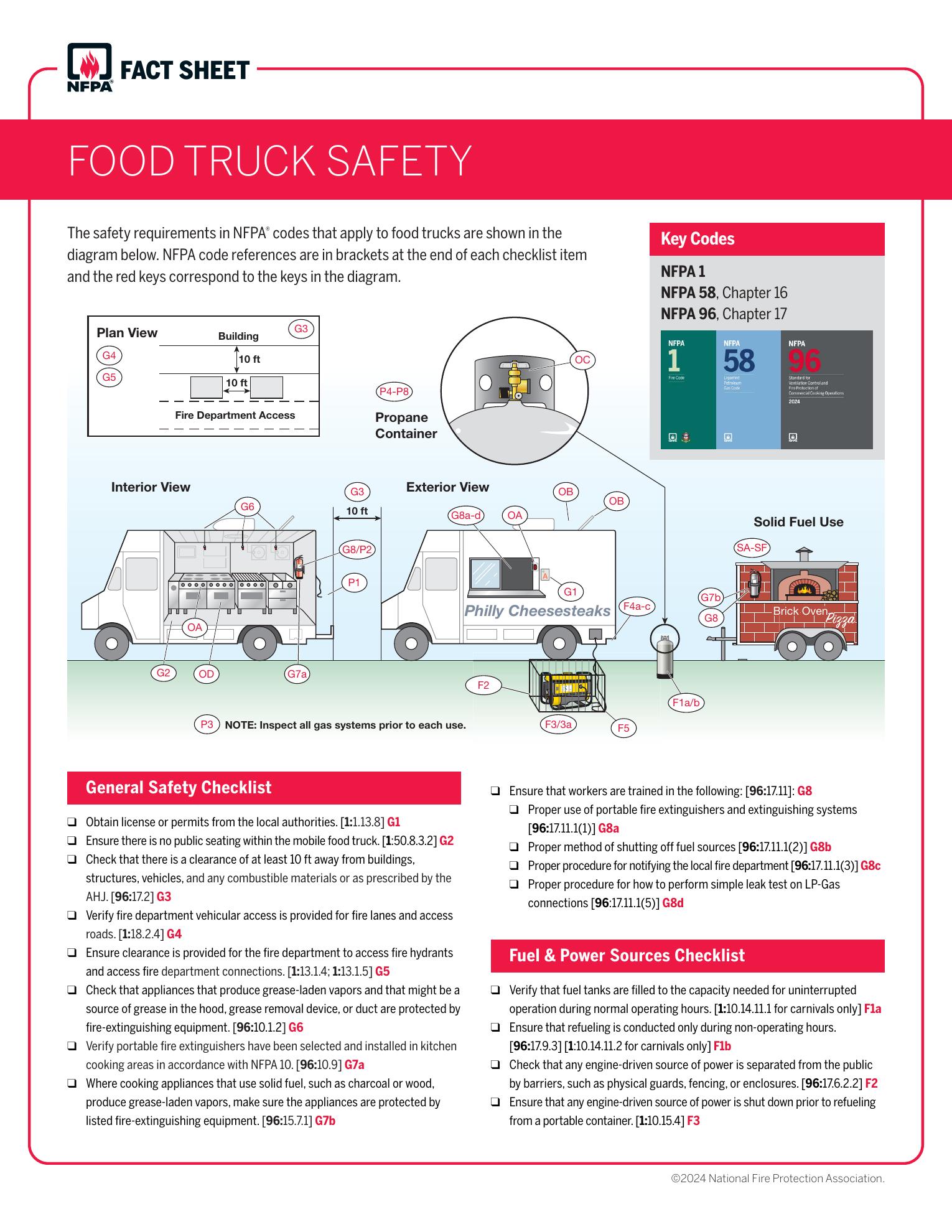
Click on the picture to download the two page NFPA Food Truck Safety Fact Sheet. The PDF file will open up in a new tab.